
Smart Vintage Scan
Discover True Value
Analyzing catalog...
Smart Vintage Scan
Discover True Value
Analyzing catalog...
August 4, 2026
A maker's mark rarely tells you an item is genuine on its own, but it's usually the fastest way to narrow down where and when something was made — which is exactly what our AI weighs heavily when it forms a verdict.
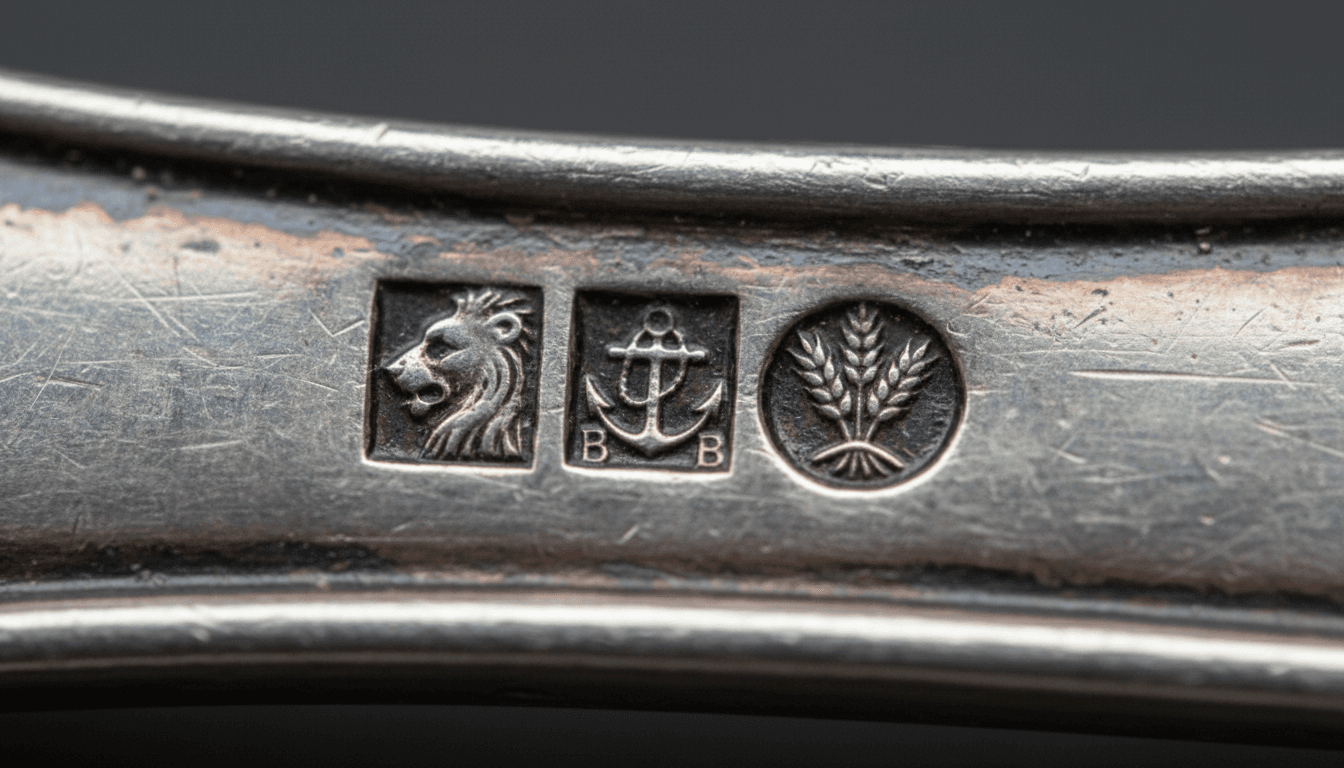
Genuine silver hallmarking systems (British, French, and most European traditions) use a set of several small stamps together: a maker's mark, a purity/fineness mark, an assay office mark, and often a date letter. If you only see one vague stamp, that's a reason for caution, not confidence — real hallmark sets are multi-part by design.
This is one of the most useful things you can photograph. A mark applied under the glaze (you can feel a perfectly smooth surface over it) is far more consistent with factory-original marking. A mark that feels slightly raised or sits on top of a glossy glaze is worth a closer look — it can indicate later decoration or an altered piece, though it isn't automatically fake.
Hand-blown glass often has a pontil mark — a rough or ground circle on the base where the piece was snapped off the blowing rod. Its presence and finish (rough, ground flat, or polished) can help date a piece. Etched or acid-stamped signatures on the base are common on later 19th–20th century art glass and are worth a dedicated close-up photo.
A correct-looking mark is supporting evidence, not proof — marks have been copied for as long as they've mattered. That's exactly why Smart Vintage's report separates the verdict (our overall read) from the confidence score (how much the visual evidence supports it), and why "Likely Genuine" pieces with lower confidence, or any high-value piece, are still worth an in-person expert opinion before you buy or sell.